
For most of human history, professional expertise was acquired through direct observation, repetition, and the gradual increase in task complexity. A student had to work alongside a master, physician, pilot, engineer, or instructor and learn the profession under real-world conditions. This approach remains valuable today; however, it has a fundamental limitation, since not every situation can be safely recreated in an educational environment. It is impossible to create emergency conditions for a novice pilot, perform surgery on a living patient solely for training purposes, or repeatedly simulate dangerous situations at a real shooting facility. This is where simulation emerges as a digital or hybrid environment in which a person interacts with a model of the real world, receives feedback, and gains the opportunity to analyze the outcome. A modern simulator is not merely a screen displaying images. It may include motion sensors, virtual or augmented reality, action-recording systems, artificial intelligence algorithms, scenario-generation tools, and subsequent analytical processing of the results.
Flight Simulator
Pilot training is one of the most obvious examples of the application of simulation technologies. A flight simulator makes it possible to reproduce various weather conditions, navigation failures, equipment malfunctions, and other circumstances that cannot or should not be created during an ordinary training flight.
The main advantage of such an environment lies not only in its safety. Simulation provides controlled complexity. An instructor can first offer a standard scenario and then gradually introduce additional variables: limited visibility, a change of route, time pressure, or the need to make decisions based on incomplete information. At the same time, every action is recorded and can be reviewed after the training session has been completed.
Artificial intelligence expands the capabilities of such systems. Algorithms can analyze not only whether the final decision was correct, but also the sequence of actions, reaction speed, frequency of errors, patterns of attention, and a person’s tendency to repeat incorrect strategies. As a result, training becomes more than mechanical repetition; it develops into an adaptive process in which the scenario is adjusted to the characteristics of a particular individual.
Virtual Reality in Medical Education
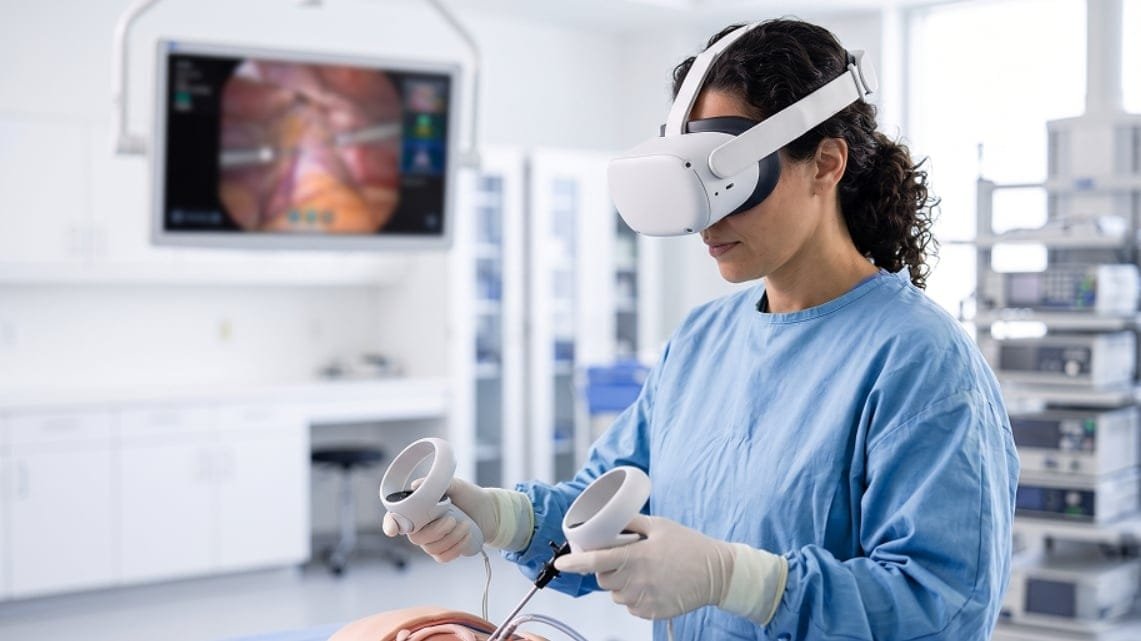
The second major area of simulation application is the training of physicians and surgeons through virtual reality. In traditional education, a medical specialist gradually progresses from theory to observation and then to performing a limited range of procedures under the supervision of an experienced mentor. This path is essential, but the number of available practical situations may be limited.
VR systems make it possible to create three-dimensional anatomical models and reproduce medical procedures in an interactive format. A trainee can study the spatial arrangement of organs, practice performing a sequence of actions, and repeat complex stages without directly endangering a patient. An important component is the possibility of receiving immediate feedback: the system can record the trajectory of movements, adherence to the required sequence, and deviations from the prescribed scenario.
At the same time, virtual reality does not replace clinical practice. Its role is to create an intermediate layer between theoretical training and real-world work. In a digital environment, trainees can develop basic coordination, spatial reasoning, and decision-making skills, and then transfer the acquired abilities to a medical setting.
Shooting Simulator
Another example is a shooting simulator designed to provide safe training and evaluate actions in a simulated environment. Such systems may use laser projection, screens, software-based scenarios, sensors, or other methods of recording user actions. Their key feature is that the training situation can be created without the constant use of live ammunition.
As an openly presented commercial example, one may mention the virtual shooting simulator developed by SHOOTING-SOFT or the iTarget training system. The specific characteristics of different systems may vary, so it is more accurate to regard them not as completely interchangeable products, but as representatives of a broader field involving digital visualization, action tracking, and safe scenario-based training.
A system can reproduce neutral or dynamic situations and then demonstrate which elements attracted the user’s attention, where delays occurred, and what decisions were made under time pressure. At the same time, such a simulator should not be regarded as a universal substitute for real-world training. It develops particular components of a skill: procedural discipline, the ability to follow an established scenario, spatial assessment, and control over the sequence of actions. Real-world conditions require additional knowledge, instruction, and compliance with applicable laws and regulations.
Conclusion
Simulation is becoming a new type of laboratory in which human decisions can be tested repeatedly without directly reproducing all the dangers of the real world. In pilot training, it helps model emergency scenarios; in medical education, it creates a safe environment for mastering complex procedures; and in shooting training, it makes it possible to practice selected behavioral elements without constantly relying on live-fire conditions.
The main value of these technologies lies not in fully copying reality, but in their ability to isolate its most important components, measure them, and gradually increase the complexity of the task. In the future, simulation platforms enhanced by artificial intelligence will likely serve less as replacements for human instructors and more as their analytical partners.


 By