
| What This Guide Covers 1. Why Automated Valuation Is PropTech’s Sharpest Edge 2. What an AVM Is and How It Works 3. The Data Pipeline: An AVM Is Only as Good as Its Data 4. The Machine Learning Models Behind an AVM 5. The India Problem, and How to Solve It 6. Accuracy, Trust, and the Human in the Loop 7. How to Implement It: A Step-by-Step Path 8. Tech Stack, Cost, and Timeline 9. Case Study: A Property Price Prediction Engine We Built 10. Best Practices and Mistakes to Avoid 11. Frequently Asked Questions |
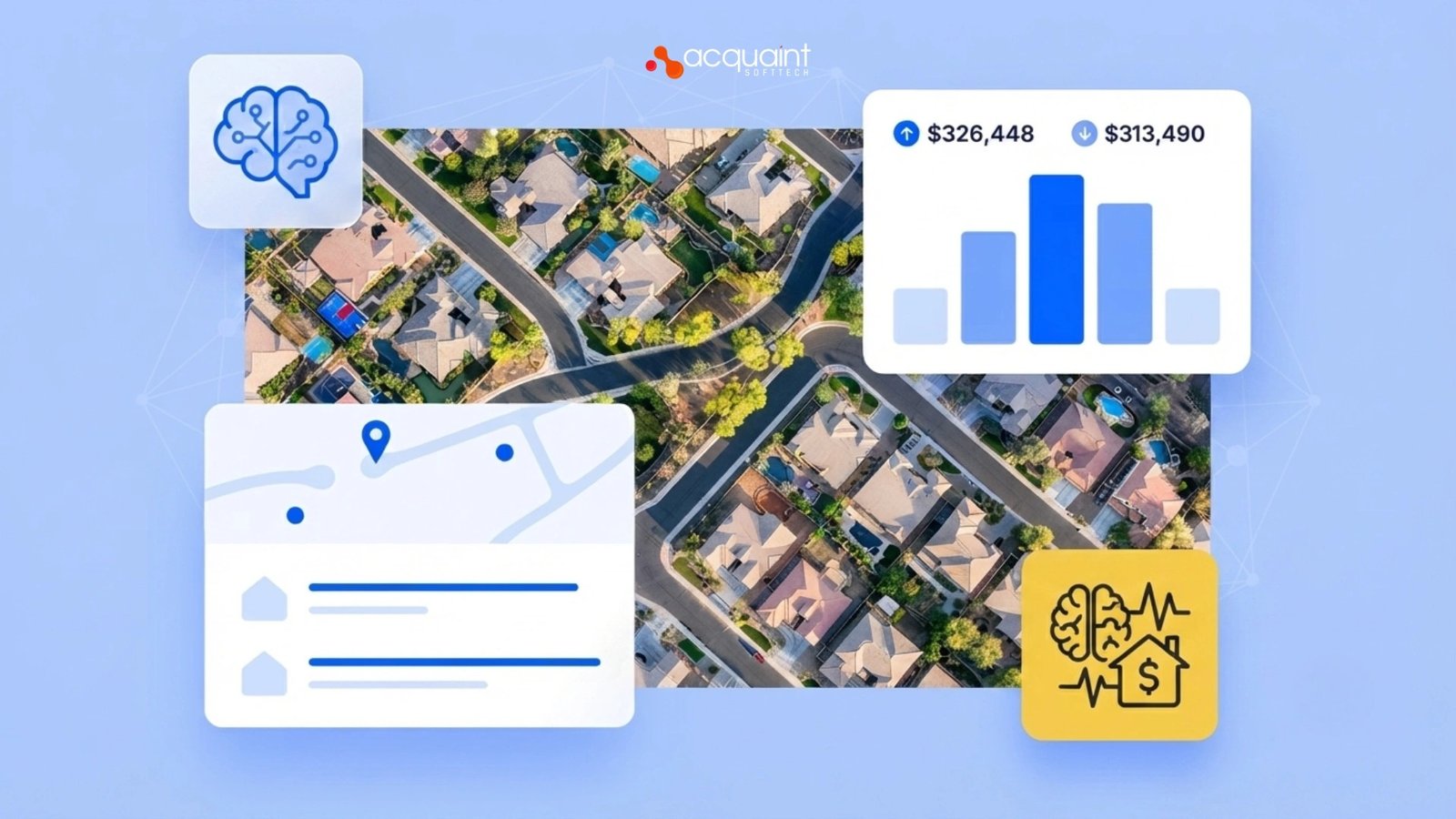
Why Automated Valuation Is PropTech’s Sharpest Edge? An automated valuation model (AVM) replaces guesswork with data-driven property estimates by analysing thousands of comparable sales instantly. Through our AI development services, we build intelligent solutions that help PropTech platforms improve pricing accuracy and decision-making.
The technology has quietly become a standard, not an experiment. Industry research finds that top AVMs now reach a median error of roughly two to three percent on standard homes in data-rich markets, though accuracy falls sharply where comparable sales data is thin or the property is unusual, as summarized in this 2026 real estate AI statistics roundup. That single caveat, accuracy depends on data, is the thread that runs through this entire guide.
An AVM is also not a standalone toy; it is a data intelligence layer that plugs into a wider property platform. Where it sits, what it feeds, and what feeds it are decisions our guide on PropTech software development frames across the full stack. Treating it as part of the platform, rather than a bolted-on calculator, is what makes it trustworthy.
The payoff is speed and confidence at scale: a portal can price every listing instantly, a lender can screen a loan in seconds, and an investor can spot a mispriced asset before anyone else. Building that engine to stay accurate and explainable over time is a software product engineering discipline, not a one-off model. The teams that treat it that way are the ones whose numbers people actually trust.
| What you are really trying to solve You want a price estimate that is fast, accurate enough to act on, and trusted by the people who read it. The hard part is rarely the model; it is the data feeding it and the confidence story around it, especially in markets where clean sales records are scarce. Solve data and trust, and the model almost takes care of itself. This article moves from what an AVM is, through data and models, to the India challenge, accuracy, implementation, and budget. |
What an AVM Is and How It Works
The short definition
An AVM is a machine learning system that predicts a property’s market value from its attributes and its context: the size, type, age, and location, measured against patterns in past sales. Where a human appraiser visits and judges, an AVM reads data and computes, returning a number and a confidence range in under a second. Putting experienced specialists on that definition, and on the engine behind it, from day one is exactly why teams hire remote developers with valuation experience.
How an AVM turns data into a number
Under the hood, an AVM does three things in sequence: it gathers features about the subject property, finds and weighs comparable transactions, and runs a trained model to output a price with an uncertainty band. The cleaner the features and the richer the comparables, the tighter that band becomes. Architecting this end-to-end flow as a maintainable platform, not a notebook experiment, is a software product development effort from the start.
A crucial design choice early on is how the model will live in production, since an AVM that cannot be retrained, monitored, and explained will rot within a year. Deciding the serving architecture, the retraining cadence, and the guardrails is a senior call our virtual CTO services help leadership get right. The framework and stack trade-offs behind that decision are weighed in our guide on Laravel vs MERN stack for startups.
The Data Pipeline: An AVM Is Only as Good as Its Data
The data an AVM needs
Every reliable AVM stands on four data layers: historical sale and listing prices, property attributes, location and geospatial context, and market signals like supply, demand, and time trends. The richer and cleaner each layer, the more accurate the estimate, which is why mature markets with open registries and listing feeds produce the tightest models. Building the ingestion and cleaning for these layers is precise backend work our Python developers do as the foundation of the whole engine.
Raw property data is messy in ways that quietly wreck a model: duplicate listings, inconsistent units, missing fields, and prices that mix asking with sold. A serious pipeline deduplicates, normalizes, and validates every record before it ever reaches a model. Standing up that disciplined data engineering, often the largest part of an AVM project, is delivered through our software development outsourcing.
Building a pipeline that stays fresh
An AVM is not built once; it is fed continuously, because a model trained on last year’s market drifts as prices move. The pipeline has to pull new sales and listings on a schedule, refresh features, and trigger retraining when accuracy slips. Running that automated, always-on data infrastructure reliably is the job of our DevOps engineers.
Freshness and scale are also a deployment problem, since the pipeline may process millions of records and serve valuations to a busy portal at the same time.
Read Also: Why Plastic Pulverizer Machine Technology Matters in Modern Recycling and Manufacturing
The Machine Learning Models Behind an AVM
From regression to gradient boosting
Most production AVMs do not start with deep learning; they start with strong, explainable tabular models. A baseline linear or regularized regression sets a floor, and gradient-boosted trees such as XGBoost or LightGBM usually become the workhorse, because they handle mixed property features and non-linear price effects well while staying fast to train. Building, tuning, and validating these models is the daily craft of our AI and ML engineers.
When deep learning earns its place
Deep learning earns its keep when the data is rich and unstructured, listing photos that hint at condition, satellite or street imagery, or text descriptions that carry signal a spreadsheet misses. These models add accuracy but demand more data, compute, and care, so they belong on top of a solid tabular baseline, not instead of one. Owning that model lifecycle, from experiment to production, is best handled by a focused dedicated software team.
Confidence scores and explainability
A price with no confidence is a liability, so a good AVM always returns an uncertainty band and a reason: this estimate is high-confidence because there are many recent nearby sales, or low-confidence. After all, the property is unusual. Techniques like quantile models and feature attribution turn a black box into something a human can trust and challenge. Serving those explanations reliably alongside the estimate uses deployment patterns from our MERN stack app deployment guide.
The India Problem, and How to Solve It
Why India is harder
India breaks the assumptions that make AVMs easy in the United States or the United Kingdom. There is no single national multiple listing service, transaction prices are often understated for tax reasons, circle rates lag the market, and the same locality can be described five different ways across sources.
The result is exactly the data-thin condition that industry research warns degrades AVM accuracy, so a model built for clean Western data will simply be wrong here. Scoping a realistic, India-aware AVM is the kind of problem a discovery workshop exists to de-risk.
Practical ways through
The way through is not to wish for clean data but to engineer around its absence. Blend many imperfect sources, registry records, portal listings, broker inputs, and ground-truth where you can get it, weight them by reliability, model locality at a fine grain, and lean harder on confidence ranges so a shaky estimate is honestly labelled as shaky. Building that resilient, multi-source approach is precise backend work our Django developers handle well.
6. Accuracy, Trust, and the Human in the Loop
Accuracy without trust is wasted, and buyers are clear about this: in one 2026 survey, a large share of people said they find AI valuations unacceptable without a prior human review, as reported in this 2026 housing-market AI analysis. The lesson is not to hide the AI but to pair it with a human and to be honest about confidence.
In practice that means designing the AVM as decision support, not an oracle: it proposes, a person reviews edge cases, and the system learns from corrections. Keeping that feedback loop running and the model honest over time is exactly what ongoing support and maintenance is for.
Trust also lives in how the number reaches people, so agents and valuers should see the estimate, its confidence, and its top drivers wherever they work, including on a phone in the field. Delivering that clear, mobile-friendly valuation experience is built by our React Native developers.
How to Implement It: A Step-by-Step Path
An AVM project succeeds or fails on sequencing, so we order it to prove value early and de-risk data first. We begin with one market and a clear target, then build the pipeline, baseline model, and confidence layer before scaling. Keeping that plan on track across data, modeling, and delivery is where a strong project manager is essential.
- Define market and target (weeks 1 to 2): pick one geography and decide what you value and how accuracy will be measured.
- Build and clean the data pipeline: ingest sales, attributes, location, and market signals, then deduplicate and validate them.
- Train a baseline, then a strong model: start with regression, move to gradient boosting, and benchmark against held-out sales.
- Add confidence and explanations: attach an uncertainty band and the top drivers to every estimate.
- Serve through an API with a human check: expose valuations to your product and route low-confidence cases to a reviewer.
- Monitor, retrain, and expand: watch live accuracy, retrain on drift, then add new markets one at a time.
The single most important rule is to resist scaling to many markets before one is genuinely accurate, since a wrong valuation erodes trust faster than a missing one. Automating the retraining and monitoring so the engine improves on its own is delivered by our automation engineers.
Tech Stack, Cost, and Timeline
The stack we use for an AVM favors a strong data and ML core with a clean serving layer: Python with pandas, scikit-learn, and XGBoost or LightGBM for modeling, PostgreSQL with PostGIS for spatial data, an orchestrated pipeline for ingestion and retraining, a model-serving API, and React on the front end. Assembling that mix quickly without a long hire is what our staff augmentation is built for.
Most of the build cost is data engineering and validation, not the model itself, which surprises teams expecting the math to be the hard part. The product and dashboard layer that surfaces valuations to users is built by our MERN stack developers.
| Build Scope | Indicative Cost (USD) | Timeline |
| AVM proof of concept (one market, baseline model) | $25K to $60K | 3 to 4 months |
| Production AVM (pipeline, API, confidence scoring) | $60K to $150K | 5 to 9 months |
| Multi-market AVM platform (retraining + monitoring) | $150K+ | 9 to 16 months |
| Data, retraining, and model upkeep | Annual retainer | Continuous |
India-based teams deliver the same scope at up to 40% lower cost, which is why many proptech founders and lenders build their AVM with a remote partner rather than an in-house data science hire. Keeping models and data tooling current as libraries and sources evolve is handled through our version upgrade services.
For platforms that want to offer valuations to other portals or lenders as a product, the same engine can be exposed as an API and resold. Productizing it that way is exactly what our white label development services enable.
Case Study: A Property Price Prediction Engine We Built
To ground this in real delivery, consider our work for Property Brokers, New Zealand’s leading provincial real estate brand with more than 850 people across 80-plus locations. The Managing Director wanted predictive valuation tools that could estimate property values from location data, historical pricing, and market dynamics, an AVM in everything but name. The marketing and web surfaces around such a platform run through our WordPress and web development capabilities, while the valuation engine itself was custom-built.
Acquaint Softtech built a centralized data ingestion system that aggregated historical sales, regional pricing, and listing activity, then developed property price prediction models that read location-based factors and market trends to generate estimated valuation ranges, backed by geospatial analysis tools and market intelligence dashboards. It is the AVM blueprint end to end: clean data in, calibrated valuation out. You can see this and related work in our portfolio of client case studies.
| Goal | Result | |
| One source of property data | Centralized ingestion across markets | |
| Data-backed valuations | AI price models with estimated value ranges | |
| Accuracy that holds up | Predicted ranges aligned with final sale prices | |
| Faster decisions | Dashboards for demand and pricing by region | |
| Property Brokers is a real, delivered valuation platform, not a concept; the client reported faster appraisals and predictive valuations that aligned closely with final sale prices once homes sold, in a verified engagement. You can check our results through 50+ client reviews on our Clutch profile, where Acquaint Softtech holds a 4.9/5 rating with Premier Verified status across 1,300+ delivered projects over 13+ years: see the Clutch profile. | ||
The same data-to-valuation approach scales from a national brokerage to a portal or lender AVM, and where a JavaScript-centric stack fits the team, that engine is delivered by our MEAN stack developers.
Best Practices and Mistakes to Avoid
What we recommend
Across the data and AI platforms we have built, a few habits separate AVMs people trust from ones they ignore. Spend most of the effort on clean, fresh data, because the model is only as honest as its inputs. Start with explainable tabular models before reaching for deep learning.
Always return a confidence range and the reasons behind an estimate. And keep a human in the loop for edge cases, especially in thin-data markets. These habits keep quality high, reinforced by the engineering record in our roundup of the best software product engineering companies in 2026.
What to avoid
The mistakes are predictable and costly. Training a slick model on dirty data, which produces confident nonsense. Shipping a single point estimate with no uncertainty, which invites blame the first time it is wrong. Reaching for deep learning before the data justifies it, which burns budget for little gain.
And scaling to many markets before one is genuinely accurate, which spreads errors faster than value. Avoiding these is mostly disciplined data and modeling work, the kind backed by robust engineering from our Laravel developers on the platform around the model.
Frequently Asked Questions
How Does AI Help with Property Valuation?
AI-powered Automated Valuation Models (AVMs) analyze property data, past sales, and market trends to estimate property values in seconds. They help lenders, real estate platforms, and investors make faster, more consistent pricing decisions.
What Is the Implementation Approach for an AVM?
Start with a single market, build a clean data pipeline, train machine learning models, and add confidence scoring. Deploy the AVM through an API, monitor accuracy continuously, and expand to new regions as data quality improves.
What Are the Best Machine Learning Models for an AVM?
Most successful AVMs use XGBoost or LightGBM for accurate predictions. Regression models are commonly used as baselines, while deep learning is valuable when property images and unstructured data are included.
How Accurate Are Automated Valuation Models?
In data-rich markets, leading AVMs achieve a median error rate of around 2%–3%. Accuracy decreases for unique properties, rural locations, and regions with limited transaction data, making confidence scoring and human review essential.
How Much Does It Cost to Build an AVM?
| Region | AVM Platform Cost | Enterprise AVM Cost |
| USA | $60,000–$150,000 | $150,000–$300,000+ |
| UK | £45,000–£120,000 | £120,000–£250,000+ |
| Europe | €50,000–€130,000 | €130,000–€280,000+ |
| India-Based Team | Up to 40% Lower Cost | Up to 40% Lower Cost |
Why Is Building an AVM Harder in India Than in the US or UK?
India’s fragmented property data, inconsistent locality naming, and limited transaction transparency make valuation more challenging. Successful AVMs must combine multiple data sources and rely heavily on confidence scoring.
Can an AVM Replace a Human Appraiser?
Not entirely. AVMs are ideal for instant property estimates and decision support, but human appraisers remain essential for high-value, complex, or unusual properties where local expertise and judgment matter.


 By
By