
Quick Answer
For most newly listed altcoins, limit orders are the safer default. They let a trader set the exact price they’re willing to pay or accept, which matters most in the opening minutes, when spreads are wide and the order book is thin. Market orders still have a place: mainly when getting filled matters more than the exact price, and there’s enough visible liquidity to support the trade size.
Key Takeaways
- Limit orders control price; market orders control speed. Neither is universally “better.”
- New listings often have wide bid-ask spreads and shallow books, making market orders more prone to poor fills.
- CoinGecko’s 2026 Spot CEX Report found only around 32% of newly listed tokens showed positive price action immediately after listing, and about 25% after 30–59 days, data that weakens the case for rushing in.
- Exchange rules (price protection, tick sizes, minimum notional values) can change how an order actually executes.
- Order size relative to available liquidity matters more than the order type itself.
What’s the Difference Between a Market Order and a Limit Order?
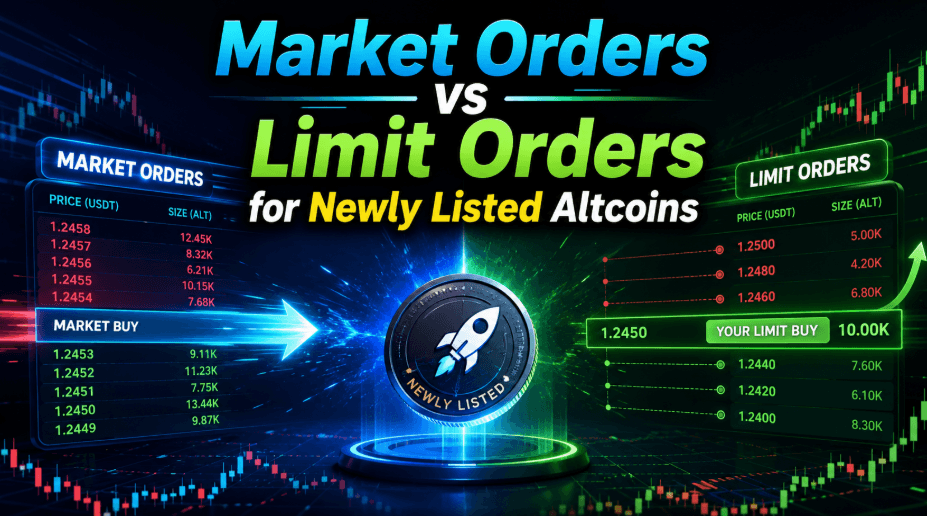
A market order executes immediately against whatever is already in the book. It prioritizes getting filled over price, a large enough order can consume several price levels, so the average fill can differ materially from the last traded price. Coinbase notes its market orders can fill at multiple prices and are always taker orders on its spot platform.
A limit order sets the maximum price to buy or minimum to sell. It guarantees price but not execution: it may fill partially, or not at all.
| Factor | Market Order | Limit Order |
| Main priority | Execution | Price |
| Price guaranteed? | No | Yes |
| Fill guaranteed? | Usually more likely | No |
| Slippage exposure | Higher | Limited to set price |
| New-listing suitability | Selective | Usually preferable |
| Main risk | Bad execution price | Missing the trade |
Why Are Market Orders Especially Risky at Listing?
A market order doesn’t buy at “the market price”, it buys from whatever liquidity currently sits in the book, level by level.
Thin books amplify slippage
Say the best ask is $1.00 for 500 tokens, with the next levels at $1.05, $1.12, and $1.25. A buy large enough to consume all four won’t average near $1.00, even though that was the displayed price. What matters is order size relative to depth, not headline volume.
Wide spreads raise the cost of speed
New tokens typically have fewer competing market makers, so the gap between best bid and ask is wider. Crossing it with a market order adds a real cost before price even moves.
Price discovery can outpace the screen
Concentrated early demand, fast repricing, early holders selling into strength, and bots reacting faster than humans can move price quicker than a manual trader can respond. This is structural to new listings, not a flaw of one exchange, smaller altcoins generally stay more volatile than deep, liquid pairs like BTC/USDT.
When Should You Use Each Order Type? (Decision Framework)
Lean toward a limit order when
You have a defined entry/exit price; the spread looks wide; visible liquidity is shallow; price is moving quickly; missing the trade beats overpaying; or your order is large relative to depth.
A market order can fit when
Immediate execution matters more than price precision; your size is small relative to liquidity; the spread has narrowed and depth looks real; or you need to exit fast because staying exposed is riskier than expected slippage. For example, when you trade ATLA USDT, the appropriate order type should depend on the pair’s live spread, depth, and your position size rather than simply assuming a newly listed token requires a market order.
Simplified rule: if the priority is “don’t pay above X,” use a limit order. If it’s “fill me now, whatever the price,” a market order may work — once liquidity actually supports it.
How Do You Set a Limit Price and Position Size?
- Check the spread, not just the last price, which can be stale within seconds. A wide spread signals unstable price discovery.
- Check depth at multiple levels, the best ask, 1% above, and 2–5% above, to see if your size would move the market alone.
- Set a maximum entry price before submitting. If anything above $1.10 is unattractive, place the limit at $1.10 rather than risking a market-order fill above it.
- Consider splitting the order across a few limit levels to spread out timing risk, accepting you may only capture part of the size.
- Don’t chase an unfilled limit by mechanically raising it, reassess spread, liquidity, and risk/reward instead.
How Do Exchange Rules Change Execution?
The same order type can behave differently across venues, so confirm a platform’s rules rather than assuming.
Coinbase applies a market-order protection point, around 10% for non-stablecoin spot pairs, beyond which the order stops and may return a partial fill; stablecoin pairs use a tighter threshold. Binance’s spot market applies tick-size, quantity-step, and minimum-notional filters, so a reasonable-looking limit order can still be rejected. MEXC notes that funds tied to an unfilled resting limit order stay locked until it fills or is canceled.
These rules aren’t universal and can change, confirm current terms and any regional restrictions before placing size.
Pre-Trade Checklist
- Exact trading start time: Deposits opening isn’t the same as spot trading opening.
- Correct trading pair: TOKEN/USDT vs. TOKEN/USDC or another quote asset.
- Bid-ask spread and order-book depth: Confirm liquidity can absorb your size.
- Circulating supply and unlock schedule: Low float or unlocks can amplify volatility.
- Supported order types and protections for that exchange.
- Maker/taker fee treatment, which can differ between resting and immediate orders.
- Maximum acceptable loss and position size, decided before the listing starts.
Most newly listed tokens don’t sustain early gains, per CoinGecko’s 2026 data, a reminder there’s rarely a strong case for rushing in.
FAQ
Is a market order or limit order better for a new coin listing?
Neither is universal, limit orders give price control, usually the priority on a volatile listing; market orders prioritize speed for trades that can’t wait.
Why did my market order fill at a much worse price than expected?
It consumed several price levels in a thin book, so the average fill reflects all liquidity used, not the top-of-book price shown before submission.
Can a limit order fail to execute?
Yes, if price never reaches your level, it stays open or expires unfilled, or fills only partially.
Do all exchanges handle market orders the same way?
No. Protection thresholds, fees, and order-book rules vary by platform.
Is it ever fine to use a market order right at listing?
Generally only for small size relative to visible depth, once the spread has narrowed and real liquidity shows up at multiple levels.
Conclusion
Limit orders are the more disciplined default for newly listed altcoins because they keep the trader, not the order book, in control of price. Market orders still earn their place when speed genuinely outweighs price precision and liquidity is demonstrably deep enough. What matters most isn’t “market vs. limit” in the abstract, it’s order size relative to spread and depth. If neither option looks attractive, waiting for the book to stabilize is a legitimate decision too.


 By
By